How to Use Operator Blocks in Scratch | Full Guide with Live Coding & Examples
Scratch Tutorial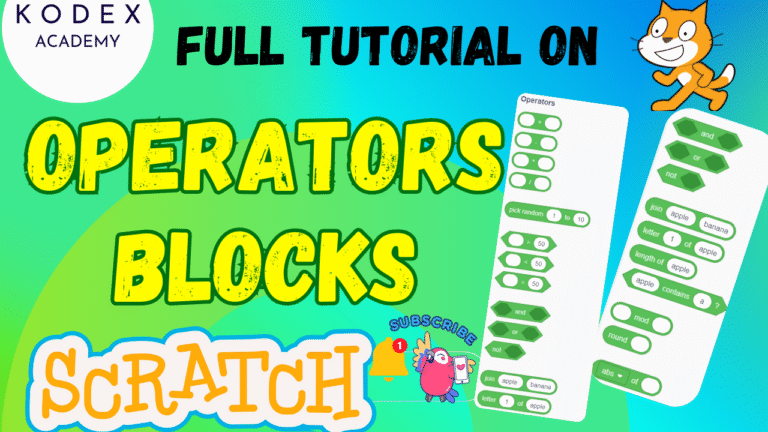
Introduction: Operator Blocks in Scratch
In the world of block-based coding, Scratch stands out as one of the best platforms for beginners to learn programming logic through interactive games, animations, and applications. One of the most powerful features in Scratch is its Operator Blocks — essential for handling math operations, logic comparisons, and string manipulations.
What You Will Learn:
This comprehensive guide teaches you how to:
- ✅ Perform mathematical operations with arithmetic operators
- ✅ Generate random numbers for dynamic behavior
- ✅ Compare values and make decisions
- ✅ Combine conditions with logical operators
- ✅ Manipulate text with string operators
- ✅ Use advanced math functions like modulus and rounding
- ✅ Build practical projects like calculators and games
👉 Watch the Full YouTube Tutorial Here:
How to Use Operator Blocks in Scratch | Full Guide with Live Coding & Examples | Kodex Academy
What Are Operator Blocks in Scratch?
Operator blocks in Scratch are green-colored blocks used to:
- • Perform mathematical operations
- • Create logic conditions
- • Handle text (string) manipulation
- • Introduce randomness
These blocks are crucial when you need decision-making logic, such as checking if a player wins a game, solving a math problem, or responding to user input.
Operator Blocks in Scratch: Step-by-Step Coding
1. Arithmetic Operators in Scratch
Used for basic math calculations: addition, subtraction, multiplication, and division.
Addition
say (result)
Subtraction
say (result)
Multiplication
say (result)
Division
say (result)
Use Case: Build a calculator in Scratch to let users perform these operations dynamically.
2. Pick Random Operator in Scratch
Used to generate random numbers within a specified range — useful in games and animations.
Example:
say (join [Your lucky number is: ] (randomNumber))
Use Case: Create a number guessing game or randomize enemy movement in a game.
3. Comparison Operators in Scratch
Used to compare values and return either true or false.
Greater Than or Less Than
say [You passed!]
else
say [Try again!]
end
Equal To
say [Correct!]
else
say [Wrong answer.]
end
Use Case: Evaluate game conditions like winning or losing based on score or timer.
4. Logical (Boolean) Operators in Scratch
Used to combine or negate conditions.
AND
say [Game Completed!]
end
OR
change y by (10)
end
NOT
say [Game Over!]
end
Use Case: Build advanced game logic where multiple conditions need to be met.
5. String Operators in Scratch
Used for text (string) manipulation, useful in quizzes, chats, or name-based logic.
Join Strings
Letter of a Word
Length of String
Contains?
say [Yes, 't' is in Scratch!]
end
Use Case: Create a program that reads user names or builds a typing game.
6. Advanced Math Functions in Scratch
These are mathematical operators used for more complex calculations.
Modulus (Remainder)
say [Even Number]
else
say [Odd Number]
end
Use Case: Even/Odd number checker
Round
say (round (4.2)) // Output: 4
Use Case: Display whole numbers in score systems or quizzes.
Absolute (Abs)
Use Case: Distance calculations or physics-based games.
Operators Table
| Operator Type | Example | Use Cases |
|---|---|---|
| Arithmetic | ((5) + (3)) | Calculator, Score calculation |
| Pick Random | (pick random (1) to (100)) | Games, AI randomness |
| Comparison | <(score) > (50)> | Game decision-making |
| Logical (Boolean) | <<(condition1) and (condition2)>> | Game level logic |
| String | (join [Hello ] [World]), (length of [Hello]) | Chat apps, Text analysis |
| Modulus | ((number) mod (2)) | Odd/Even checker |
| Round | (round (3.6)) | Clean display of decimal values |
| Abs | (abs (-5)) | Game movement, physics |
Hands-On: Make a Calculator in Scratch
Features:
- Takes two numbers as input
- User selects the operation (+, -, *, /)
- Displays result
Blocks Used:
ask(Sensing)if-else(Control)+ - * /(Operators)set variable(Variables)
Sample Code:
ask [What operation? +, -, *, /] and wait
set [operation v] to (answer)
ask [Enter first number] and wait
set [num1 v] to (answer)
ask [Enter second number] and wait
set [num2 v] to (answer)
if <(operation) = [+]> then
set [result v] to ((num1) + (num2))
else
if <(operation) = [-]> then
set [result v] to ((num1) - (num2))
else
if <(operation) = [*]> then
set [result v] to ((num1) * (num2))
else
if <(operation) = [/]> then
set [result v] to ((num1) / (num2))
end
end
end
end
say (join [Result: ] (result)) for (10) seconds
Odd/Even Number Checker (Using Modulus)
Objective:
Check if a number is even or odd using the mod operator.
Code:
ask [Enter a number:] and wait
set [num v] to (answer)
if <((num) mod (2)) = (0)> then
say [The number is even] for (10) seconds
else
say [The number is odd] for (10) seconds
end
Enhancement Features
1. Input Validation
say [Please enter a valid number!]
end
2. Custom Result Display with Looks Block
say (join [Your result is: ] (result)) for (5) seconds
3. Game Score Logic with Booleans
say [Level Complete!]
else
say [Try Again!]
end
4. Mini Game with Random Numbers
ask [Guess a number from 1 to 10] and wait
if <(answer) = (target)> then
say [Correct! 🎉]
else
say [Wrong! It was ] + (target)
end
Conclusion: Mastering Operator Blocks in Scratch
Operator blocks are the backbone of logic, math, and text manipulation in Scratch programming. Whether you're building a calculator, a logic-based game, or a text recognition app, understanding how to use these green-colored blocks unlocks a world of possibilities.
In this tutorial, you learned how to use Arithmetic Operators for calculations, apply the Pick Random block for dynamic behavior, perform comparisons using Comparison Operators, create logic using Boolean Operators like AND, OR, and NOT, manipulate text with String Operators, and perform advanced operations with Modulus, Round, and Absolute Value.
By mastering these, you're not just learning Scratch — you're building computational thinking skills that apply to all programming languages.
Call to Action
Don't forget to check out the full video tutorial and subscribe to Kodex Academy for more Scratch content!
Visit kodexacademy.com for more tutorials.
Next Steps: Learn More with Kodex Academy
At Kodex Academy, we're passionate about helping students learn coding in creative ways. This project teaches more than Scratch—it empowers young minds to build tools that work in the real world.
Explore more:
Stay updated with new content, free tutorials, and coding challenges!
- 🌐 Website: https://kodexacademy.com/
- 💬 WhatsApp Channel: Join Now
- 💼 LinkedIn: Kodex Academy
- 📸 Instagram: @kodex_academy
- 𝕏 Twitter: @Kodex_Academy
- 📢 Telegram: Join Our Channel
- 🎗 Patreon: patreon.com/KodexAcademy
Further Reading & Links
- Scratch Wiki Motion Blocks: https://en.scratch-wiki.info/wiki/Motion_Blocks
- Scratch Programming for Beginners: https://scratch.mit.edu/projects/editor
- Scratch Animation Guide: https://en.scratch-wiki.info/wiki/Animating